
16 June 2026
Is Your Corporate Job Still the Safe Choice? What South Africa's Employment Data Reveals
South Africa's corporate job market is stagnating, not collapsing. A realist's read of the Stats SA data, and what it means if you're weighing your next move.
Most corporate professionals carry an unspoken assumption into every career decision: the job is the safe option, and starting something of your own is the risk. The salary arrives every month. The medical aid is sorted. The risk lives somewhere else, in the world of people who quit to chase an idea.
For most of the last thirty years that was a fair description of South African working life. It is no longer a reliable one. Not because corporate jobs are disappearing in a dramatic collapse, and not because the robots are coming for everyone next Tuesday. The reason is quieter and more structural than either of those stories. Corporate employment in South Africa has stopped growing, and "not growing" in a country with this population is a slower, less visible kind of risk than the word "safe" suggests.
This article is not an argument for quitting. The same data that should make you question the safety of staying should also make you cautious about the alternative, because the macro weakness that is squeezing corporate roles makes new businesses harder to build at the same time. The argument here is narrower and more useful than "leap" or "stay put." It is this: make the stay-or-leave decision on purpose, using current information, rather than defaulting to "stay" on the strength of an assumption you formed in a labour market that no longer exists.
What follows is the data, two patterns inside it that the headline coverage tends to miss, and what both mean if you are sitting in a mid-career white-collar role wondering whether the ground under you is as solid as it feels.
The short version
- South Africa's formal sector employed about 10.55 million people in December 2025, and shed roughly 102 000 jobs over the year. The trend is flat to mildly down, not growing.
- The working-age population grows by around half a million people a year. Formal employers are adding close to nothing. That gap, not outright decline, is the real story.
- Retrenchments in South Africa are slow and costly, so companies shrink quietly instead, through frozen vacancies and natural attrition. You often cannot see it until it reaches your own desk.
- White-collar, process-heavy roles are now exposed in a way they were not in previous automation waves.
- None of this is a reason to quit. It is a reason to stop treating "stay" as the risk-free default.
Is the corporate job market growing or shrinking?
Start with the official numbers, because most of the noise in this debate comes from people quoting one quarter or one survey and ignoring the rest.
South Africa has two official measures of employment, and they are built differently. The Quarterly Employment Statistics (QES) counts jobs by surveying employers, which makes it the closest read we have on formal, payrolled, corporate roles. The Quarterly Labour Force Survey (QLFS) counts people by surveying households, which captures the informal economy the QES cannot see. They disagree at the edges. On the direction of travel, they agree.
According to the QES, formal non-agricultural employment stood at 10.55 million in December 2025, after losing about 102 000 jobs over the preceding year. The household survey is bleaker for the most recent quarter on record: in the first quarter of 2026, the number of people in work fell by 345 000 to 16.8 million, formal-sector employment dropped by 189 000, and the official unemployment rate rose to 32.7%, up from 31.4% the quarter before.
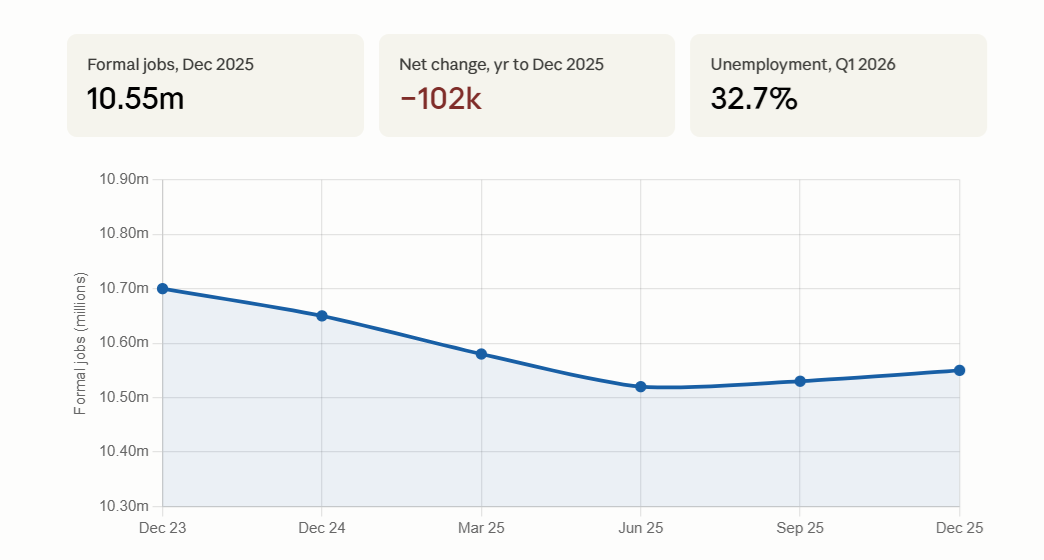
Figure 1. Formal non-agricultural employment in South Africa, December 2023 to December 2025. Source: Statistics South Africa, Quarterly Employment Statistics.
The longer view is harder to read than it looks, because Stats SA re-benchmarked the QES during this period, which shifts the level of the series without anyone being hired or fired. That is why the honest measure is the year-on-year change within each release, not the raw headline number across vintages. Read that way, the pattern is consistent.
| Period | Formal employment (QES) | Year-on-year change | Note |
|---|---|---|---|
| Dec 2021 to Dec 2022 | about 9.97m | minus 94 000 | Earlier survey benchmark |
| Dec 2022 to Dec 2023 | about 10.70m | plus 98 000 | Re-benchmarked; the level step is mostly a survey revision |
| Mar 2024 to Mar 2025 | about 10.58m | minus 95 000 | Current benchmark |
| Dec 2024 to Dec 2025 | 10.55m | minus 102 000 | Current benchmark |
Source: Statistics South Africa, Quarterly Employment Statistics. Year-on-year figures are the reliable comparison; level figures across the period are affected by survey re-benchmarking.
Strip out the survey noise and the conclusion holds. The corporate job market is not in freefall. It is also not growing. It has spent five years roughly where it started, while the country around it has not stood still at all.
The absorption gap
Here is the first thing the "growing or shrinking" framing gets wrong. It treats the question as a yes or no about the number of jobs. The more important number is the relationship between that figure and the population it has to absorb.
The working-age population reached 42.2 million in early 2026 and grows by more than 120 000 people every quarter, roughly half a million a year. Formal employers are adding close to nothing. The arithmetic only goes one way. On the Stats SA numbers, the share of working-age South Africans in any kind of income-earning work sat at around 40% in 2025, against an international norm closer to 60%.
Call it the absorption gap. The economy is not shedding corporate jobs at speed. It is failing to create them at anywhere near the rate the population requires. That distinction matters for how the risk actually reaches you.
A market that is shrinking fast is frightening but legible. You can see the retrenchments. You update your plans. A market that is merely failing to grow is more insidious, because nothing dramatic happens to signal it. What you get instead is a slow tightening. Fewer rungs open above you. More competition for each internal move. Longer gaps between the job you have and the next one you want. External offers that take longer to arrive and concede less when they do. None of it announces itself. You feel it as a career that has become harder to move through, and you tend to blame yourself rather than the structure.
The data backs the slow-tightening read. The share of unemployed South Africans who have been out of work for more than a year climbed from about 65% in 2016 to over 77% in 2026. People who leave the formal market are taking longer and longer to get back in. That is the cost of the absorption gap made concrete, and it is worth sitting with if you have been assuming you could always find another corporate seat if this one disappeared.
Silent attrition
The second pattern explains why the squeeze stays invisible until it lands on you.
South African labour law makes formal retrenchment slow and expensive. Section 189 of the Labour Relations Act forces consultation, process, and cost on any employer that wants to cut roles outright. The practical effect is that most South African companies do not do dramatic, announced layoffs. They do something quieter. They leave roles unfilled when people resign. They let natural attrition shrink the headcount over time. And, increasingly, they let software absorb the work that the departed person used to do.
This is not a prediction. It is already being described openly. In reporting through late 2025 and early 2026, South Africa's largest retail bank set out exactly this approach: keep vacancies frozen and let artificial intelligence take up the workload rather than backfilling the role. Attrition needs no consultation. There is no Section 189 process to run when you simply choose not to replace someone.
Call it silent attrition. The corporate workforce shrinks not through a wave of retrenchments you can read about, but through thousands of quiet decisions not to rehire, each one invisible from the outside. The total shows up in the Stats SA numbers as a flat line. It does not show up in your inbox as a warning.
For an individual in a corporate role, silent attrition changes what you should be watching. The signal is not a retrenchment announcement. It is your own function getting quietly leaner. The colleague who left and was never replaced. The team that absorbed an extra portfolio without extra people. The process you used to own that now runs through a tool with your occasional supervision. These are the early indicators that your role is being eroded by attrition rather than eliminated by decision, and they are easy to rationalise as temporary while they are happening.
The roles most exposed
Previous automation waves mostly displaced industrial and manual labour. This one is different, and the difference matters specifically for the people Launchworks tends to speak to.
The work most exposed to current automation is white-collar and process-heavy: banking operations, business process outsourcing, administration, the structured analytical and clerical tasks that fill the middle of a corporate org chart. That middle is exactly where a large share of mid-career corporate professionals sit. The roles that once looked safest because they were skilled and indoor and salaried are now among the more exposed, because "skilled, structured, repeatable" is a fair description of what the technology does well.
It is uneven, though, not a uniform decline, and the exception is instructive. Business services, which covers finance, professional, technical and outsourced work, remains the largest formal employer and one of the few still adding roles, with more than 2.5 million people employed at an average of around R31 600 a month in early 2025. A meaningful slice of that growth is South African professionals delivering services to clients offshore. The work that is holding up is the work that is specialised, judgement-heavy, and sold to a market wider than the local economy. The work under pressure is the work that is routine, internal, and replicable. That contrast is worth more than any single headline number, because it tells you something about where durable value sits.
Why the pay rise is not the reassurance it looks like
There is a number in the data that seems to contradict everything above, and it is worth confronting directly. Average monthly earnings in the formal sector reached R29 690 in November 2025, up 4.9% on the year. Pay is rising. Surely that means corporate work is healthy?
It means the opposite of what it appears to. When headcount falls while the total wage bill holds or grows, average pay per worker rises by arithmetic alone. Fewer people, each earning a little more, is the statistical signature of a workforce being thinned, not strengthened. It is sometimes called jobless wage growth, and it cuts in two directions at once for anyone weighing their position.
If you keep your seat, you are probably paid more than you were, which raises the cost of walking away from it. That is real, and you should weigh it honestly. But the same pattern means there are fewer seats and slower movement between them, which raises the cost of staying in a market that is quietly closing exits. The rising salary is not evidence of a secure, expanding career. It is what a tightening market looks like from the inside, for the people who have not yet been tightened out.
So should you leave?
No. Or at least, nothing in this data says you should.
It is tempting to read a stagnant corporate market as a push toward starting your own thing, and plenty of content online will frame it that way. That reading is wrong, and it is worth being blunt about why. The same economic weakness that has frozen corporate hiring also makes new businesses harder to start and harder to keep alive. South Africa has thin rates of entrepreneurship and high small-business failure for reasons that are mostly structural, and a difficult macro environment does not spare founders. The data on why the informal economy does not simply absorb the difference is worth reading in full. Quitting a stagnant job for a fragile business is not a hedge against risk. In most cases it is a larger bet, taken with less of a safety net.
What the data actually argues for is smaller and more demanding than a leap. Stop treating "stay" as the risk-free default and "leave" as the only decision that carries danger. Both carry risk now. Once you accept that, the question stops being "should I be brave enough to leave?" and becomes "which risk am I better positioned to carry, and have I done the work to find out?"
That work is specific. It means being honest about how exposed your particular role is to silent attrition. It means understanding your real financial runway rather than your imagined one. If you are seriously weighing it, the most sensible first move is not to resign. It is to test a business idea while you still have the salary, and to do the harder internal work of assessing whether you can function without the scaffolds corporate life has been quietly providing. Neither of those requires courage. They require honesty, which is rarer.
What the numbers can and cannot tell you
A few honest limits, because anyone presenting this data as settled is overselling it.
The QES level series is not continuous across the full five years, because Stats SA re-benchmarked it during the period. Anyone who tells you "formal jobs grew from 9.6 million to 10.5 million" is reading a survey revision as hiring. The year-on-year figures within each release are the reliable comparison, and those are the ones used above.
The household survey is volatile from one quarter to the next, because it samples households rather than counting payrolls. A single quarter's swing of a few hundred thousand should not be over-read in either direction. The trend across several quarters is what carries weight.
And the two surveys diverge by design, one counting jobs and the other counting people, which is why the responsible read triangulates between them rather than leaning on whichever number suits the argument. On the central point, that the corporate market has stagnated against a growing population, both surveys and several years of data point the same way.
A quieter conclusion
The loud version of this story is the one about artificial intelligence coming for the jobs, mass displacement, a reckoning. It makes for sharp headlines and it is mostly the wrong frequency. The real story is quieter and harder to dramatise. Corporate employment in South Africa has not collapsed. It has stagnated, while the population and the cost of living have not. The shrinkage that is happening is happening silently, one unfilled vacancy at a time, in a way that gives you very little warning.
The assumption worth retiring is not "my job is safe." It is the older, deeper one underneath it: that staying is the cautious choice and leaving is the risky one. In this market, staying carries its own risk, and the most dangerous thing you can do with that risk is fail to notice it.
The point is not to panic, and it is certainly not to leap. It is to look at your own position with clear eyes, understand which way the ground is actually moving, and make your next decision deliberately. If you are reading this carefully rather than skimming it, you are already doing the part most people skip.